
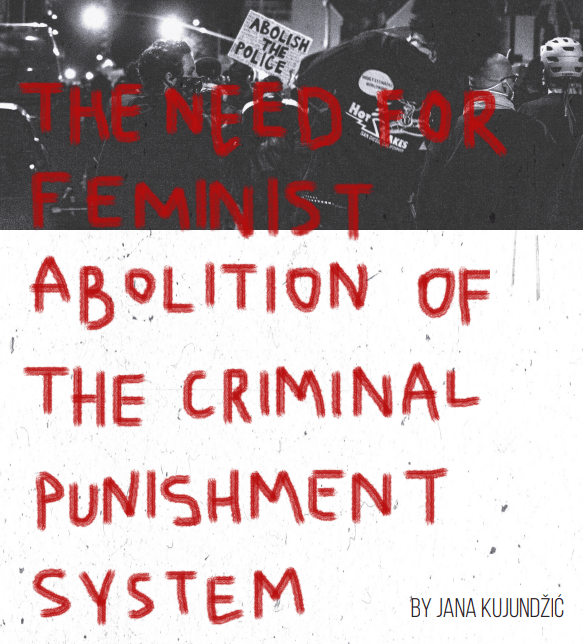
Zazivanje strožih kazni zatvora za orodnjeno i seksualno nasilje postalo je zdravorazumska praksa diljem svijeta pa tako i u našem regionu. Naša Jana u ovom tekstu piše kako kaznenopravni sustav nije rješenje za nasilje već njegov sastavni dio. Većina preživjelih istraumatizirana je postupanjem policije, suđenjima te zatvorima koji su mjesta gdje je nasilje normalizirano. Potrebna je korjenita promjena društva u kojem je briga na prvom mjestu, a represivni državni organi zamijenjeni zajedničkom odgovornosti i brigom.
The criminal punishment system is presented as a common-sense solution for social issues classified as illegal acts or crimes. The black-and-white story goes like this: some bad people do bad things; the police exist to catch them, and laws exist to mediate a fair punishment. It is argued that the prisons as punishment present a more “civilised” version of punishments than the historical public shaming, flogging and hanging. However, across the world, prisons remain inherently violent spaces in which sexual violence is structural and mundane in the form of non-consensual body searches, invasions of bodily privacy and neglect of health-related issues. As Sarah Lamble (2011) notes, the prison is not an unsafe space because the prisoners inside it are inherently violent, but because the prison itself is a site of violence.
According to the Prison Matters 2024 report from the United Nations Office for Drugs and Crime, more than 11.5 million people are estimated to be in prison globally. This is the highest number of imprisoned people ever and a 24% increase since 2000 (a rate slightly lower than the estimated growth in the world’s general population). Prison overcrowding remains a critical issue in many countries, with prisons operating above official capacity in 121 countries. Even though prison overcrowding is not a problem in Croatia on the same scale as in the US and the UK, it does suffer from a lack of rehabilitation programs as well as the use of inadequate, hygienic conditions, derelict facilities and insufficient health care for imprisoned people (Getoš Kalac, Bezić and Šprem, 2021). Contrary to popular opinion, the majority of people globally are not imprisoned for violent crimes but for property and drug-related offences. Even more alarmingly, around one in three people in prison globally are being held in pre-trial detention without having been convicted or sentenced. This essentially means that, legally, innocent people are being held in a cage.
At the time of the writing, the genocide in Palestine has decimated the already suffering population. There is a high number, 500 to 700 annually, according to the Defence for Children International-Palestine (DCIP), of Palestinian children being prosecuted for the “crime” of stone-throwing by the Israeli military court system. More than 270 Palestinian children are currently held in Israeli detention. According to the Save the Children 2022 report, these children are subjected to inhumane treatment, coercive interrogation and denial of essential services such as healthcare or education, which constitutes a breach of international law. Furthermore, Israel recently passed a law allowing Palestinian children under 14 to be jailed. As Angela Davis has explained in her seminal work, Freedom is a Constant Struggle (2016), the prison infrastructure in occupied Palestine was directly imported from the US industrial prison complex. Davis points out that the United States subsidises Israeli military power to the tune of billions of dollars annually, that Israeli police have long had training partnerships with U.S. police, and that the same transnational security interests, including massive, Western-based, multinational corporations like G4S, are investing in building walls and cages for people from the West Bank to the Rio Grande. Davis (2016: 22) invites us to interrogate our attachments to prisons and punishment:
“The site of the jail or prison is not only material and objective … it’s ideological and psychic as well. We internalise the notion of a place to put bad people. That’s precisely one of the reasons we have to imagine the abolitionist movement as addressing those ideological and psychic issues as well. Not just the process of removing material institutions.”
The common-sense stories that justify prisons and policing are a part of what Clare Hemmings (2011) calls the political “grammar”. In other words, we make sense of the world by telling stories that draw on assumptions and meanings, which, in turn, co-create these very stories in the process. It is common sense to report a crime to the police, who then process it through the appropriate channels within the criminal justice system. What is left out of this common-sense story is that the origins of the police have roots in colonialism and property protection rather than protecting people from harm. Furthermore, the process of criminal proceedings for gendered crimes is notoriously long and traumatic for the survivors, with the end goal of locking the person who caused harm in a cage, which is supposed to reform them.
In 2007, sociologist Elizabeth Bernstein coined the term “carceral feminism” to describe the efforts of antitrafficking feminists to criminalise sex work via aggressive law enforcement measures. Since then, the concept has evolved to define the firm reliance of feminist groups on coercive state institutions – prisons, police and the criminal justice system – to punish sexual and gender violence. Over the last fifty years, carceral responses to domestic violence and rape have become accepted as common sense in most countries. The problem with carceral feminism is that, as a result of neoliberalism, it embraces the mindset of individual accountability, framing the systemic issue of hetero-patriarchal violence as a matter of individual pathology.
Studies have found that in countries where carceral feminist legislations are passed, in the form of harsher penalties for perpetrators, women are less likely to report domestic violence (Srinivasan, 2021). The possibility of having to run a household alone, in the absence of state economic support, is felt by many women as more fearful than living with those who harm them. In essence, carceral solutions to gender justice obscure the socio-political determinants of most crime, such as poverty, borders, and racial oppression. Carceral feminism diverts attention from neoliberal cuts to social welfare programs that allow survivors to escape harmful situations. It also discourages alternative responses to gender and sexual violence, including community accountability and transformative justice. Furthermore, research consistently shows that higher incarceration rates are not associated with lower violent crime rates (Stemen, 2017).
In former Yugoslav countries, criminal punishment systems were involved in prosecuting a wide range of crimes stemming from the violent dissolution of the socialist federal republic in the 90s. These include war crimes, corruption, and gendered violence. According to Impunity Watch (2019)’s policy brief titled ‘Balkan Chronicle: Gender Equality, Transitional Justice and the International Community,’ the main problem with gender equality and transitional justice policy in the region is its narrow focus on promoting legislation to address sexual violence and wartime harm. This has led to ignoring the more structural causes of violence, such as the persistent economic harm, social stigmatisation, and discrimination that have contributed to violence against women throughout the history of the region. The brief argued that ignoring the underlying root causes of violence and concentrating solely on the outward signs of violence, such as rape and torture, will not bring the much-needed societal transformation. The formation of NGOs across the region, along with their demands to reform the legislation and align it with various international standards and conventions on the rights of victims, is fueling the legitimacy of the criminal punishment system as the final arbiter of justice.
The first women’s shelters across the region were squats led by radical feminists who challenged the state’s indifference to domestic violence (Boric, 2003). The ideology of the first shelters was anti-state. However, this was quickly replaced by absorption into the NGO industrial complex, aligning those feminists with liberal feminists seeking to gain power within the status quo. Feminist campaigns against domestic and sexual violence have not only been co-opted by the carceral state, but they have also been integral ingredients to the evolution of the criminal legal system as an apparatus of control. This evolution also impacted those supposed to be advocated for and protected by feminist campaigns. Survivors of abuse have been arrested and prosecuted for refusing to cooperate with carceral agendas (Phipps, 2020).
As has frequently been described, women’s experiences of reporting sexual assault to sceptical police and their subjection to victim-blaming examinations in criminal trials are as traumatising as the sexual assault itself. Ivana Radačić, in her seminal book on sexual violence (Seksualno nasilje: mitovi, stereotipi i pravni sustav, 2014), exposed how the law, in addition to reflecting rape myths and gender stereotypes, simultaneously supports and constructs these myths. These myths are based on the notions of “real rape” and the “ideal victim.” The idea of “real rape” constitutes an attack by an unknown person in a public place that the victim resists with all her might. An “ideal victim” is a chaste and responsible person who does everything to avoid the risk of rape, reacts to the trauma in a certain way, is visibly disturbed by the event and reports violence immediately. However, the experiences of most raped people do not fit into that scenario. In most cases, women are raped by men they know, very often in their homes or other places known to the victim, and they are usually
Paradoxically, victims of sexual violence are far more likely to be punished by the criminal legal system than to secure a conviction of the person who harmed them. According to the U.S. Commission on Civil Rights (2020), as many as 90% of people held in US women’s prison facilities have experienced sexual or domestic violence. While we have no such research conducted in women’s prisons across the region, it would be safe to assume that many women currently held in prison had experienced domestic violence or sexual assault before their incarceration. Furthermore, anti-violence campaigns in the ‘80s and ’90s led to policies that required police to respond to domestic violence calls to make an arrest; these are called pro-arrest policies. These policies resulted in a 60% increase in the arrest of men and a 400% increase in the arrest of women (Rajan and McCloskey, 2008). Victims of domestic violence had limited access to alternative modes of intervention and resources, and domestic homicide rates increased. The Prison Reform Trust found similar trends in the UK following the passage of expanded police powers under the Domestic Abuse Act. There is a lack of proper research on dual arrests in Croatia. Still, the Gender Equality Ombudsman has been warning since 2011 that the practice of dual arrests in cases of domestic abuse is a problem of police practice which needs to be curtailed.
The narrow focus of some feminists on making violence against women a crime has overshadowed issues related to systemic gender oppression. There is an enormous contradiction in feminist demands for the incarceration of abusers and rapists, as these are attempts to seek justice within the institutions of state violence. This is what Audre Lorde would call the “master’s tools”. When justified rage is used to promote incarceration, the maintenance and expansion of the carceral state are vindicated. These most vulnerable moments are when carceral feminist logic infiltrates feminist politics and derails abolitionist world-building.
The concept of accountability is essential in approaches that focus on transformative justice: the idea of individual responsibility, which is central to punitive justice, ignores the broader systemic influences that foster hetero-patriarchal violence. In other words, if sexism exists as a system, then the responsibility also lies collectively rather than individually. For feminist abolition organiser Marieme Kaba, dismantling the prison-industrial complex involves establishing alternative methods of accountability and governance that do not rely on domination, hierarchy, and control. Envisioning and advocating for a world without prisons and policing requires re-evaluating the state’s function within society, along with a fundamental commitment to transforming every social relationship.
References
Al-Naser, H. A., Brown, M., Rausis, D., & Schwabe, M. (2024). PRISON MATTERS 2024: Global Prison Population and Trends, A Focus on Rehabilitation. United Nations Office on Drugs and Crime.
Boric, R. (2003). Feminizam i etika- kriticke analize. Zarez- Dvotjednik Za Kulturna i Drustvena Zbivanja, 2(106), 2–47.
Davis, A. Y. (2016). Freedom Is a Constant Struggle: Ferguson, Palestine, and the Foundations of a Movement. Haymarket Books.
Getoš Kalac, A.-M., Bezić, R., & Šprem, P. (2021). “Ružno pače” hrvatskoga kaznenog pravosuđa – zatvorski sustav u svjetlu domaćih i europskih trendova. Godišnjak Akademije Pravnih Znanosti Hrvatske, 12(1), 83–112.
Hemmings, C. (2011). Why Stories Matter: The Political Grammar of Feminist Theory. Duke University Press.
Impunity Watch. (2019). Balkan Chronicle: Gender Equality, Transitional Justice and the International Community. Balkan Transitional Justice Initiative Project
Lamble, S. (2011). Transforming Carceral Logics: 10 Reasons to Dismantle the Prison Industrial Complex Through Queer/Trans Analysis and Action. In E. A. Stanley & N. Smith (Eds.), Captive Genders: Trans Embodiment and the Prison Industrial Complex (pp. 235–265). AK Press. https://trueleappress.files.wordpress.com/2017/11/stanely-smith-captive-genders.pdf
Phipps, A. (2020). Me Not You: The Trouble with Mainstream Feminism. Manchester University Press.
Prison Reform Trust. (2022). Prison: the facts. https://prisonreformtrust.org.uk/wp-content/uploads/2022/07/Prison-the-facts-2022.pdf
Radačić, I. (2014). Seksualno nasilje: Mitovi, stereotipi i pravni sustav. Tim Press.
Rajan, M., & McCloskey, K. A. (2008). Victims of intimate partner violence: Arrest rates across recent studies. In Journal of Aggression, Maltreatment and Trauma (Vol. 15, Issues 3–4, pp. 27–52).
Save the Children. (2020). Defenceless: The impact of the Israeli military detention system on Palestinian children. http://www.childreninmilitarycustody.org.uk/wp-content/uploads/2012/03/Children_in_Military_Custody_
Stemen, D. (2017). The Prison Paradox: More Incarceration Will Not Make Us Safer. Vera Institute of Justice.
Srinivasan, A. (2021). The Right to Sex. Bloomsbury Publishing.
U.S Commission on Civil Rights. (2020). Women in Prison: Seeking Justice Behind Bars. www.usccr.gov

 REGIONALNI ABOLICIONISTIČKI FEMINISTIČKI KOLEKTIV
You must be logged in to post a comment.